How to Choose a Perfume Manufacturer:
A Decision-Maker's Guide for Brands
Understanding how to choose the correct perfume manufacturer
Introduction
Choosing a perfume manufacturer is one of the most consequential decisions a fragrance brand will make. The manufacturer you select will shape the quality of your product, your ability to scale, your cost structure, and your exposure to regulatory and reputational risk. Yet the process is often approached without a clear framework, leaving brands to discover critical incompatibilities only after contracts are signed.
This guide is written for brand owners, procurement leads, and executives evaluating private label perfume manufacturing partnerships. It covers the criteria that matter, the questions that reveal a manufacturer’s actual capabilities, and the structural considerations that determine whether a partnership will survive growth.
1. Define Your Requirements Before You Approach Any Manufacturer
Before evaluating any manufacturer, you need a clear internal brief. Manufacturers vary significantly in their specialisations: some excel at high-concentration attars and ouds, others at EDP and EDT formulations, others at functional fragrance for personal care. Approaching manufacturers without defined requirements leads to mismatched proposals and wasted time on both sides.
Your brief should include at minimum:
- Fragrance type and concentration (Attar, EDP, EDT, EDC, solid perfume, or functional fragrance)
- Target volume per SKU and estimated annual production
- Packaging requirements, including bottle type, cap style, and filling specifications
- Regulatory markets: UAE, EU, GCC, US, or other jurisdictions
- Launch timeline and any phased scaling expectations
- Budget range per unit at target volume
With this brief established, you can assess whether a manufacturer is structured to serve your category rather than attempting to adapt a general capability to your specific needs.
2. Evaluate Formulation Depth, Not Just Formulation Claims
Nearly every contract fragrance manufacturer will claim formulation capability. What distinguishes serious partners from generic operators is the depth of that capability: the sourcing networks for raw materials, the in-house evaluation process, and the ability to develop a brief from scratch rather than simply adjusting a base formula.
In-House Development vs. Third-Party Bases
Some manufacturers source pre-blended fragrance bases from external suppliers and adjust concentration or top notes. This limits differentiation and creates a situation where multiple brands may share near-identical formulations. If exclusivity and product distinctiveness matter to your brand, confirm whether formulation work happens in-house and whether your formula will be proprietary to your brand under the terms of the agreement.
Stability and Longevity Testing
A formulation that performs well in the lab may behave differently at scale, in heat, or after extended shelf periods. Ask whether the manufacturer conducts accelerated stability testing and what the standard evaluation window is before a formula is approved for production. This is particularly relevant for markets with high ambient temperatures such as the GCC and the wider Middle East.
Raw Material Transparency
IFRA compliance requires that ingredients used in a formulation meet defined concentration limits for specific product categories. A manufacturer working to credible standards should be able to provide confirmation of IFRA conformance for each formula and disclose the supplier origin of key raw materials where required by your target market’s labelling regulations.
3. Assess Minimum Order Quantities Against Your Commercial Model
MOQ is one of the most practical filters in manufacturer selection. MOQs vary considerably depending on the manufacturer’s production infrastructure, filling equipment, and sourcing commitments. A manufacturer set up for runs of 10,000 units per SKU is not appropriate for a brand launching with 500 units per variant, and vice versa.
When evaluating MOQ, consider the full picture:
- Per-SKU MOQ for fragrance filling
- MOQ requirements for packaging components (bottles, caps, boxes, labels)
- Whether MOQs apply per order or per formula development commitment
- How MOQs change as volume scales, and whether pricing tiers are clearly defined
A manufacturer who cannot articulate MOQ structures clearly or who presents highly variable pricing without a volume-based framework is likely to create cost unpredictability as your brand grows.
4. Verify Regulatory Competence for Your Target Markets
Regulatory non-compliance can result in shipment detention, market withdrawal, and reputational damage. The manufacturer you choose should have established processes for ensuring that finished products meet the requirements of your intended distribution markets.
Key regulatory considerations by market include:
- UAE and GCC: ESMA certification and Emirates Authority for Standardisation and Metrology compliance for products sold in the UAE
- European Union: CPNP notification requirement, IFRA compliance, and EU Cosmetics Regulation ingredient disclosure
- United States: FDA cosmetic labelling requirements, IFRA conformity, and state-specific regulations for certain ingredients
- Global: IFRA membership and formulation within the IFRA Code of Practice for fragrance materials
Ask manufacturers how they manage ingredient updates when IFRA issues new amendments, and whether they provide documentation to support your regulatory notifications in each target market. A manufacturer without this infrastructure places the compliance burden entirely on you.

5. Scrutinize Confidentiality and IP Ownership Provisions
Your fragrance formula is a commercial asset. If it is developed with a manufacturer who retains the right to use, license, or adapt it for other clients, you have no exclusive product. This is a fundamental risk that many brands overlook until a competing product surfaces in the same market.
Before entering any manufacturing agreement, confirm in writing:
- Formula ownership: who holds the IP for any formula developed during the engagement
- Exclusivity: whether the formula will be offered or adapted for other brands
- NDA scope: what information is covered, for how long, and under what jurisdictional law
- Data handling: how formulation records and client briefs are stored and who has access
A manufacturer who resists a robust NDA or who is vague about formula ownership terms should be treated as a structural risk, regardless of other capabilities.
6. Assess Packaging Compatibility and the Filling Process
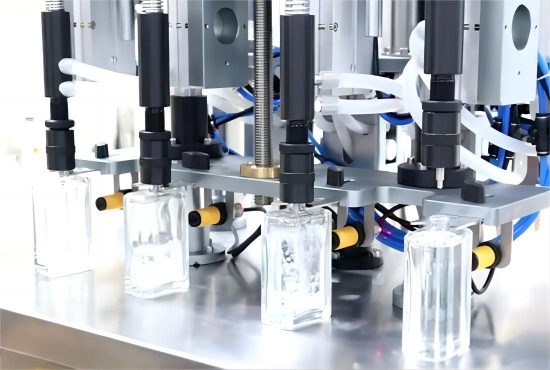
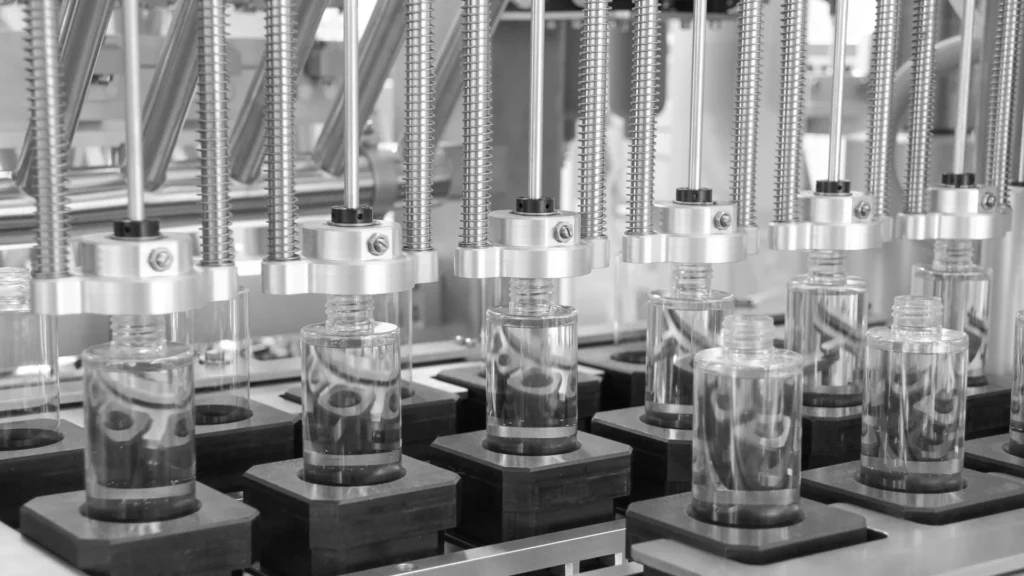
Fragrance filling is a precision process. The compatibility of a formulation with a given bottle material, pump mechanism, and cap closure determines both fill quality and long-term product integrity. A manufacturer with strong formulation capability but limited filling infrastructure will create friction at the production stage.
Glass and Material Compatibility
Certain fragrance ingredients can react with plastic components, degrade seals, or cause corrosion in metal components over time. Confirm that your manufacturer conducts compatibility testing for the packaging components you intend to use, particularly if your formulation is high-concentration or contains unusual ingredient profiles.
Filling Precision and Tolerance
Fill weight tolerance is a key quality metric. Professional manufacturers operate within defined tolerance ranges and conduct fill weight checks during production runs. Ask what tolerance standards are applied and how out-of-tolerance units are handled in the quality control process.
Packaging Sourcing and Lead Times
Some manufacturers offer packaging procurement as part of their service, which simplifies logistics but may limit your access to preferred suppliers or bespoke bottle designs. Clarify whether you can supply your own packaging components, what the lead time implications are, and how the manufacturer manages component inventory across multiple client SKUs.
7. Evaluate Scalability and Production Capacity
A manufacturer who can meet your launch volume may not be structured to support the volumes you will need at 18 or 36 months. If your brand strategy projects meaningful growth, the manufacturing partnership needs to be evaluated for scalability from the outset.
Key questions to assess scalability:
- What is the maximum monthly production capacity per SKU?
- How is production scheduled across clients, and what are standard lead times at higher volumes?
- Does the facility have the equipment to handle line extensions (e.g., different concentrations or formats) without a full re-qualification process?
- What is the process for formula reformulation if a raw material becomes unavailable at scale?
A manufacturer with constrained capacity who is already operating near full utilisation presents a supply continuity risk as your volume grows.
Frequently Asked Questions
What is a reasonable MOQ for a private label perfume brand just starting out?
MOQ requirements vary by manufacturer, but most professional private label perfume manufacturers in the Gulf and globally operate with MOQs between 300 and 1,000 units per SKU for filled fragrance. Packaging components, particularly bespoke bottles, often carry higher MOQs driven by glass production economics. It is advisable to align your launch SKU count with your available capital to avoid being spread thin across too many variants at or near MOQ.
How do I know if a perfume manufacturer’s formulation is truly exclusive to my brand?
Exclusivity is a contractual matter, not an implied one. It must be stated explicitly in your manufacturing agreement, covering both the specific formula and any derivative formulations. The agreement should also define what constitutes a sufficiently similar formula to prevent near-identical products being offered to other brands. Without written exclusivity terms, you have no enforceable claim.
What certifications should a reputable perfume manufacturer hold?
The most relevant standards for a credible private label perfume manufacturer include IFRA conformance for formulations, ISO 9001 for quality management systems, and market-specific regulatory compliance such as ESMA certification for UAE distribution or CPNP notification support for EU markets. GMP (Good Manufacturing Practice) alignment is also relevant, particularly for brands targeting distribution through regulated retail channels.
How long does the development process typically take from brief to production?
For a fully custom formulation, the development process typically spans 8 to 16 weeks from brief submission to approved sample, depending on the complexity of the brief and the number of revision iterations required. Production lead times after formula approval add a further 4 to 8 weeks depending on packaging procurement and production scheduling. Brands planning seasonal launches or time-sensitive market entries should factor this timeline into their planning from the outset.
Can I supply my own fragrance formula to a contract manufacturer?
Yes, many private label manufacturers can work with a client-owned formula, subject to raw material sourcing capability and compatibility with their production systems. In this scenario, the manufacturer should sign documentation confirming that the formula remains the client’s IP and will not be shared or adapted for other clients. The manufacturer’s role is then production execution rather than development, which may affect pricing and the scope of quality guarantees offered.
Final Thoughts
Selecting a perfume manufacturer is not a procurement decision in the transactional sense. It is a partnership decision that will influence your product quality, brand positioning, regulatory standing, and ability to grow. The criteria outlined in this guide are not exhaustive, but they address the variables most commonly responsible for failed or underperforming manufacturing relationships.
A manufacturer who meets a high standard across formulation capability, compliance infrastructure, confidentiality practice, and scalability is a genuine commercial asset. The selection process deserves the same rigour you would apply to any significant business relationship.
Start with the right strategy, the right product, and the right partner.