How to Start a Perfume Brand in the UAE:
A Practical Guide for Founders
A practical guide to starting a perfume brand in the UAE, covering business registration, ESMA compliance, manufacturer selection, and the full launch process.
Introduction
The UAE occupies a distinct position in the global fragrance industry. It is simultaneously one of the world’s highest per-capita fragrance consuming markets, a manufacturing base for regional and global fragrance production, a distribution gateway to the GCC and broader Middle East, and an increasingly active market for independently founded fragrance brands.
Starting a perfume brand in the UAE requires navigating a specific set of regulatory, commercial, and manufacturing considerations that differ meaningfully from launching in European or North American markets. The olfactive preferences of the regional consumer, the regulatory framework governing cosmetic products, the business licensing structure, and the expectations of UAE-based distributors and retail channels all shape the decisions a founder needs to make before and during the launch process.
This guide covers the essential steps for founding a perfume brand in the UAE, from initial business structuring through regulatory compliance, manufacturer selection, and the considerations specific to competing effectively in this market.
Understanding the UAE Fragrance Market
Before any operational step is taken, a founder entering the UAE fragrance market needs an accurate picture of the commercial environment they are entering. The UAE is not a single fragrance market; it is a layered one with distinct consumer segments, purchasing behaviours, and distribution channels operating in parallel.
Olfactive Preferences and Product Expectations
The Gulf fragrance consumer has historically favoured high-concentration, long-lasting fragrances with depth and warmth. Oud, amber, musk, and rose occupy a central position in regional preferences, and pure oil-based Attars remain a significant product category alongside alcohol-based EDPs and EDTs. This does not mean that lighter or more Western-influenced fragrance profiles have no market in the UAE; the market is cosmopolitan and its consumers are globally travelled and olfactively diverse. However, a brand that enters the UAE market without a product or range that acknowledges regional preferences is limiting its addressable audience from the outset.
The Competitive Landscape
The UAE fragrance market includes established regional houses, international luxury brands, a growing tier of independently founded local brands, and a significant volume of lower-quality imported product. The independently founded segment has expanded considerably over the past decade, driven by the accessibility of private label manufacturing and the growing appetite among UAE and GCC consumers for brands with a distinct identity and regional heritage.
The competitive risk for a new brand in this environment is not that the market is too mature, but that product differentiation is insufficient. With manufacturing infrastructure widely accessible, many new brands in the UAE enter with similar product profiles, similar packaging aesthetics, and similar channel strategies. The brands that establish durable market positions are those with clearly defined positioning, a distinct product identity grounded in a proprietary formula, and a coherent distribution strategy.
1. Business Registration and Licensing
Operating a perfume brand in the UAE requires a valid trade licence. The structure of that licence depends on where and how the business will operate.
Mainland vs Free Zone
UAE businesses can be established either on the mainland under a Department of Economic Development licence or within one of the country’s free zones. Each structure has distinct implications for ownership, where business can be conducted, and operational requirements.
Mainland licences allow the business to trade directly anywhere in the UAE, including with government entities and through UAE retail channels, without a local distribution intermediary. Free zone licences offer 100 percent foreign ownership and certain tax and customs advantages but historically restricted direct trading on the UAE mainland, though recent regulatory changes have broadened the scope of permitted activities for some free zone entities.
For a perfume brand intending to sell through UAE retail, distribute to regional retailers, or operate a showroom or boutique, a mainland licence or a free zone structure with confirmed mainland trading permissions is generally the more practical foundation. The appropriate structure depends on the brand’s specific operational and distribution model and should be confirmed with a UAE business setup advisor before registration.
Trade Licence Activity Classification
The trade licence must include the relevant activity classification for the business. For a perfume brand, the relevant classifications typically include the trading of perfumes and cosmetics and, if manufacturing operations will be conducted within the UAE, the relevant manufacturing activity. Importing finished products from an external private label manufacturer requires an import licence and trader classification rather than a manufacturing one.
Trademark Registration
Brand name and logo registration under the UAE Ministry of Economy’s trademark system should be completed before the brand enters the market. The UAE trademark register operates on a class-based system, and fragrance brands should register under the relevant class covering perfumes, cosmetics, and related goods. Trademark registration in the UAE does not automatically extend to other GCC markets; brands with regional distribution ambitions should consider parallel registration in Saudi Arabia and other target markets at an early stage.
2. Regulatory Compliance: ESMA and Product Registration
Products sold in the UAE market must comply with the regulatory framework administered by the Emirates Authority for Standardisation and Metrology (ESMA). For perfumes and fragrance products, this means meeting the requirements of the relevant UAE technical regulations and obtaining the necessary product registration before commercial sale.
ESMA Certification for Fragrance Products
ESMA sets the conformity requirements for cosmetic and personal care products sold in the UAE, including perfumes. Products must meet defined standards covering labelling, ingredient compliance, packaging safety, and product safety documentation. A Certificate of Conformity is required to import and sell fragrance products through UAE retail and distribution channels.
The ESMA registration process requires the submission of the product’s complete formula, safety data, IFRA conformance documentation, and labelling for review. The process is conducted through ESMA’s product certification system, and the timeline from submission to certificate issuance typically runs four to ten weeks depending on product complexity and documentation completeness.
Labelling Requirements
UAE labelling regulations require that perfume products carry specific information in both Arabic and English. Required elements include the product name, brand name, country of manufacture, net contents, full ingredient list in INCI nomenclature, batch number, manufacturing date or expiry date, and the importer’s name and address for products manufactured outside the UAE. Non-compliant labelling is a common cause of customs clearance delays and ESMA registration rejection.
IFRA Compliance
Regardless of target market, all fragrance formulas should be developed in conformance with the International Fragrance Association’s standards. IFRA sets permitted concentration limits for fragrance ingredients based on safety assessments, and these limits differ by product category and application type. A manufacturer working to professional standards will produce an IFRA conformance certificate for each formula as part of the development process. This document is required for ESMA registration and for regulatory filings in other major export markets.
Selecting a Private Label Manufacturer for the UAE Market
The selection of a manufacturing partner is one of the most consequential decisions in building a UAE fragrance brand. The criteria for manufacturer selection are covered in detail in Kayan Al Rooh’s guide to choosing a perfume manufacturer, but there are specific considerations that apply when the primary market is the UAE and the GCC.
Regional Formulation Expertise
A manufacturer with genuine regional formulation expertise understands the olfactive expectations of the Gulf consumer, has experience developing and stabilising high-concentration formulas suited to the regional climate, and can formulate with the raw materials that anchor regional fragrance preferences, including high-quality oud, amber, and natural musks. A manufacturer whose portfolio is exclusively oriented toward Western European fragrance profiles may produce technically proficient work that fails commercially in the UAE market because it does not meet the consumer’s performance and olfactive expectations.
ESMA Compliance Support
A UAE-based or UAE-experienced manufacturer should be able to provide the documentation required for ESMA product registration as part of the production service. This includes the formula safety documentation, IFRA conformance certificate, and product specification data needed for the registration submission. A manufacturer who is unfamiliar with ESMA requirements places the compliance administration burden entirely on the brand, which extends the timeline to market entry and introduces unnecessary regulatory risk.
Proximity and Supply Chain
A manufacturer based in the UAE or the wider Gulf region offers logistical advantages for brands distributing in the GCC market: shorter lead times, lower import costs, no customs complications for UAE distribution, and the ability to conduct facility visits and in-person sample evaluations without international travel. For brands building a regional distribution network, proximity also supports faster response to reorder requirements and production scaling.
3. Product Development Considerations for the UAE Market
Formula Development for the Regional Climate
Fragrance stability in high-ambient-temperature environments is a non-negotiable product quality standard for UAE distribution. Accelerated stability testing should be conducted under conditions that simulate Gulf climate storage and transportation, including exposure to elevated temperatures and humidity levels that represent realistic handling conditions in the regional supply chain. A formula that degrades under these conditions will generate consumer complaints and returns regardless of how well it performs in controlled-environment testing.
Concentration Strategy
The Gulf fragrance market supports a wider range of concentrations than most other major markets. Pure oil Attars, high-concentration EDPs at 25 to 35 percent, and traditional spray EDTs all have defined consumer segments and retail channels in the UAE. A brand entering the market with a single concentration SKU is making a deliberate positioning choice that should be grounded in channel and consumer analysis rather than defaulting to a Western standard.
For brands with sufficient capital, launching with two concentration variants that serve different consumer segments and price points from the outset provides a broader commercial base and allows the brand to gather comparative sales data to inform subsequent range development.
Packaging for the Regional Market
UAE fragrance consumers and buyers are highly attuned to packaging quality. The packaging presentation of a fragrance product in this market carries significant weight in the purchase decision, particularly in the gift and selective distribution segments. Bottle design, material quality, cap weight, secondary packaging, and the detail of finishing treatments such as frosting, engraving, or hot stamping all contribute to the perceived value of the product.
Packaging sourced at the lowest available cost is immediately identifiable in this market and positions the brand in a commodity tier from which recovery is difficult. The packaging investment should reflect the price point and consumer expectation at the channel the brand intends to occupy.
4. Distribution and Channel Strategy
UAE Retail Channels
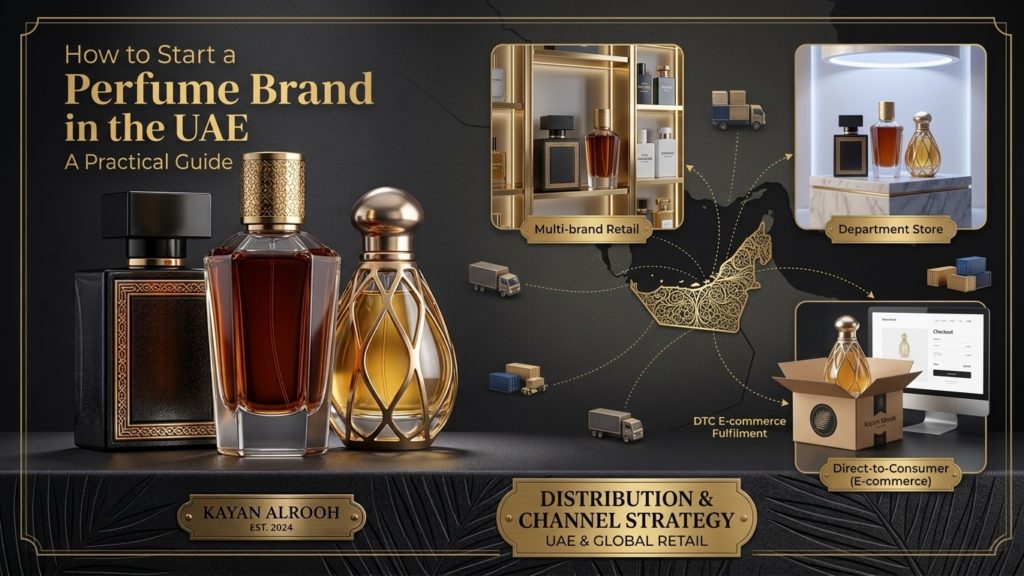
The UAE fragrance retail landscape includes multi-brand luxury perfumeries, department store fragrance counters, duty-free retail, independent boutiques, pharmacy and personal care chains, and a growing direct-to-consumer e-commerce segment. Each channel has different margin structures, listing requirements, sell-through expectations, and brand profile implications.
For an independently founded brand without established distribution relationships, building a retail presence in the UAE typically begins with selective boutique and specialty channel placements rather than broad multi-door distribution. This approach allows the brand to generate sell-through data, develop consumer word of mouth, and establish a product track record before approaching higher-volume channels that require more substantial marketing investment and inventory commitment.
Distributor Relationships
Many brands entering the UAE and GCC fragrance market work with a regional distributor who manages retail relationships, logistics, and local marketing activation. A distributor relationship simplifies market entry but transfers significant commercial control to the distributor. The distribution agreement should define exclusivity scope, minimum purchase commitments, marketing obligations, pricing controls, and the conditions under which the brand can terminate the arrangement or take distribution back in-house.
Entering a distributor agreement without minimum purchase commitments is a common mistake for new brands. A distributor with no volume obligation has no commercial incentive to actively sell the brand over the other lines they carry. Define the minimum annual purchase volume in the agreement and build in a review mechanism at 12 months.
Direct-to-Consumer
An e-commerce presence in the UAE and the GCC is increasingly viable and serves a commercial function beyond direct sales: it provides the brand with a consumer-facing platform that supports distributor conversations, communicates brand positioning, and generates data on consumer interest and purchasing behaviour. UAE e-commerce logistics infrastructure is well-developed, and local fulfilment options for fragrance products are readily available.
5. UAE Perfume Brand Launch Roadmap
The table below outlines the key phases and typical durations for launching a private label perfume brand in the UAE. Phases 4 and 5 can run in parallel to compress the overall timeline.
Phase | Key Activities | Typical Duration |
01 | Brand strategy, name, and product positioning | 2 to 4 weeks |
02 | Business registration and trade licence | 2 to 6 weeks |
03 | Manufacturer selection and NDA execution | 1 to 3 weeks |
04 | Fragrance brief and development | 8 to 16 weeks |
05 | Packaging specification and sourcing | 4 to 8 weeks |
06 | ESMA certification and regulatory compliance | 4 to 10 weeks |
07 | Production run and QC | 3 to 5 weeks |
08 | Brand identity, website, and launch preparation | 4 to 8 weeks |
| Total estimated timeline to first launch | 6 to 12 months |
The timeline assumes a clean brand strategy decision, prompt brief submission, two to three formulation revision cycles, and no material regulatory complications. Brands facing trademark conflicts, complex ESMA submissions, or custom packaging with extended supplier lead times should plan additional contingency at the relevant phases.
6. Frequently Asked Questions
Do I need to be based in the UAE to start a perfume brand that sells in the UAE?
No. Many brands selling in the UAE are founded and operated by owners based outside the country. However, a UAE trade licence is required to import and distribute products commercially through UAE retail and distribution channels. This licence can be held by a UAE-registered entity with a foreign owner, either through a mainland free zone structure or with a local service agent arrangement depending on the licence type. A UAE-based operations manager or local representative is practical for managing regulatory submissions, distributor relationships, and logistics, but the founding team does not need to be resident in the UAE.
What is the minimum investment required to launch a perfume brand in the UAE?
The total investment to launch a private label perfume brand in the UAE varies considerably based on the number of SKUs, packaging quality, production volume, and marketing scope. At a conservative estimate, a single-SKU launch with professional packaging, ESMA-compliant product registration, basic brand identity, and a modest initial production run requires a minimum investment in the range of AED 80,000 to AED 150,000. Brands targeting selective distribution with premium packaging, a multi-SKU range, and a credible marketing launch should budget significantly more. The cost breakdown guide in our Insights section provides a detailed analysis of each cost component.
How long does ESMA product registration take?
The ESMA product registration process for fragrance products typically takes four to ten weeks from submission of a complete documentation package. Incomplete submissions, missing safety data, or labelling that does not meet UAE regulatory requirements will extend the timeline. Brands should initiate the ESMA registration process as soon as the formula is approved and packaging specifications are finalised, in parallel with the production run rather than after it. Attempting to sell or import a fragrance product in the UAE without ESMA registration exposes the brand and its distribution partners to customs detention and market withdrawal.
Can I manufacture my perfume outside the UAE and still sell it in the UAE?
Yes. The UAE does not require that fragrance products sold in the market be manufactured domestically. Products manufactured in any country can be imported and sold in the UAE provided they meet ESMA compliance requirements, carry the required Arabic and English labelling, and are imported by a UAE-registered entity with the relevant trade licence. Many brands selling in the UAE source their manufacturing from the UAE, France, Switzerland, India, or other established fragrance manufacturing geographies. The manufacturing location is a supply chain and quality decision; ESMA compliance is a product and documentation decision.
What makes the UAE fragrance market different from Western European markets for a new brand?
Several structural differences shape how a brand needs to approach the UAE market compared to a Western European launch. Olfactive preferences in the Gulf are distinct, with higher expectations around concentration, longevity, and the presence of regionally favoured materials. Regulatory compliance involves ESMA rather than CPNP and EU Cosmetics Regulation. The distribution landscape involves a strong regional distributor model rather than the direct-to-retail approach common in European markets. The gifting culture in the UAE also drives a product and packaging quality expectation that reflects the significant proportion of fragrance purchases made as gifts. Brands that enter the UAE market with a product and strategy designed for a different geography typically underperform not because the market rejected them, but because the product was not designed for the market it entered.
Final Thoughts
The UAE is one of the most commercially attractive markets in the world for a well-positioned fragrance brand. It rewards product quality, brand clarity, and a genuine understanding of its consumers with strong margins, loyal purchasers, and a distribution network that can carry a successful brand rapidly across the wider GCC and Middle East region.
The barriers to entry are real but manageable: regulatory compliance requires documentation discipline, manufacturing selection requires careful evaluation, and distribution requires relationship investment. None of these barriers are prohibitive for a founder who approaches the process with the same rigour they would apply to any serious commercial undertaking.
The brands that build durable positions in the UAE fragrance market share a common foundation: a proprietary product developed for the market it enters, a manufacturing partner with the capability and compliance infrastructure to support regional distribution, and a brand identity that gives consumers a reason to choose them over an established alternative. These are not advantages that come with budget; they come with preparation.